
A neutral conductor can run hotter than expected even when every phase current appears acceptable. That is the purchasing problem behind power cable harmonic current: the cable schedule may show three balanced phases, while triplen harmonics from drives, LED supplies, servers or other electronic loads add in the neutral instead of cancelling. A buyer who receives only nominal amperes cannot see that duty in a quotation.
The useful review starts with measured or responsibly estimated load spectra, the neutral arrangement, route temperature, grouping and protection. It ends with a cable construction and evidence package that the project engineer can approve. This guide does not offer a universal derating number; the correct value belongs to the approved design method and the actual installation.
For an expansion, identify nonlinear loads, shared neutrals and equipment that may alter the spectrum.

Night Shift Clue: The Neutral Was Hotter Than the Phases
Situation: A distribution board serving electronic production equipment shows ordinary phase readings during a daytime spot check, yet infrared inspections during full night-shift output repeatedly flag the neutral termination.
Finding: The original schedule records diversified kilowatts but not the harmonic content or shared-neutral arrangement. The cable was therefore compared as a conventional balanced load, and the inspection time missed the highest nonlinear duty.
Decision: The owner records simultaneous phase and neutral current, identifies the load mix by operating state, checks the termination and reviews the installed route with the responsible electrical engineer before approving any replacement size.
Result: The corrective purchase is based on a defined operating window and circuit boundary, while the retained measurements give commissioning and maintenance teams a baseline for later equipment changes.
Treat power cable harmonic current as a measured operating case, with the circuit boundary and load state attached to every comparison.
Four Questions That Expose Harmonic Duty Early
A short technical conversation can reveal whether the RFQ describes the real current waveform or only its fundamental-load summary.
Which equipment shapes the waveform?
List variable-speed drives, switch-mode power supplies, UPS systems, lighting drivers and other nonlinear groups by feeder. Name operating combinations rather than assuming every connected load reaches full output together.
Does the circuit have a full, reduced or shared neutral?
Record the conductor arrangement exactly as installed or proposed. The answer changes how the project evaluates zero-sequence components, conductor loading and termination space.
When were currents measured?
A single midday reading may not represent a production shift, charging cycle or computing peak. Keep time, load state, instrument setup and measurement location with the values.
What else heats the route?
Ambient temperature, circuit grouping, enclosure entry, tray congestion and adjacent heat sources still matter. Harmonic duty does not erase the ordinary thermal conditions used in cable selection.
The power cable harmonic current review should reconcile the neutral path with terminations, joints and any parallel conductor arrangement.
Build a Measurement File Before Comparing Cable Sizes
Use the following fields to turn a waveform observation into a reviewable power cable harmonic current record.
| Field | What to capture | Why procurement needs it |
|---|---|---|
| Circuit boundary | Source board, feeder, neutral arrangement and connected panels | Prevents data from one circuit being applied to another |
| Operating state | Shift, equipment combination, loading and measurement time | Shows whether the reading represents credible maximum duty |
| Electrical values | Phase currents, neutral current, spectrum or THD data and voltage condition | Supports the engineer's calculation basis |
| Route condition | Length, installation method, grouping, ambient and enclosure entry | Connects electrical duty with heat dissipation |
| Instrument evidence | Model, setup, calibration status and raw files | Makes later review or repeat measurement possible |
| Decision owner | Engineer, reviewer, date, assumptions and accepted action | Keeps purchasing from turning an observation into an unapproved design |
If measured data are unavailable at tender stage, label the engineering assumption and the later verification hold point instead of presenting the assumption as a site fact.
Any response to power cable harmonic current needs an approved design decision plus product and field evidence from the correct owners.
Read Neutral Heating as a System Symptom
Power cable harmonic current passes through conductors, lugs, joints and bus interfaces. A hot neutral termination may indicate waveform duty, a poor connection, unequal paths or several causes together. Separate them before blaming the cable.
Give the neutral its own identity in drawings and test records. Permanent phase, path and endpoint names connect current readings, torque records and infrared observations with the same physical conductor.
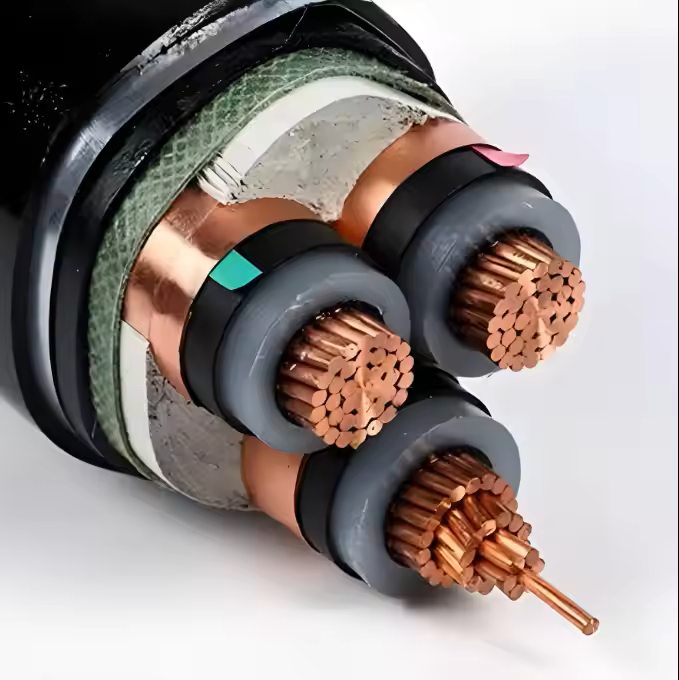
Require the supplier to state conductor arrangement, finished dimensions and relevant factory evidence. Site loading, protection and acceptance remain with the project authority.
Factory documents define the supplied cable; power cable harmonic current at site remains tied to the installed load and route.
Compare Three Responses to a Harmonic-Rich Circuit
The appropriate response depends on measured duty, route constraints and the approved electrical design; it should not be chosen by slogan.
| Response path | Useful when | Evidence to demand | Trade-off to review |
|---|---|---|---|
| Reconfirm the existing circuit | Measurements show margin and the termination condition explains heating | Load-state data, connection inspection and signed disposition | Requires credible measurements across representative operation |
| Revise conductor or neutral arrangement | The approved study finds insufficient thermal capacity | Calculation basis, cable construction, accessory fit and protection review | May change diameter, entries, drums and installation labor |
| Reduce harmonic burden | Equipment or filtering changes can address the source | System study, equipment responsibility and post-change verification | Introduces interfaces outside the cable supply |
A technically comparable quotation makes clear which path is included, which data were supplied by the buyer, and which decisions remain outside the cable manufacturer's scope.
Before release, keep power cable harmonic current assumptions, calculations, observations and accepted actions under one circuit identity.
Factory Evidence and Site Evidence Are Not Interchangeable
A cable factory can document the manufactured product, while the operating site must prove the installed waveform and thermal environment.
- Factory records can identify conductor material, nominal cross-section, construction, length, drum and routine electrical results.
- Site records should identify actual phase and neutral currents, load state, route grouping, ambient conditions, terminations and any observed temperature rise.
- The design file should connect product properties with installation and harmonic inputs.
- The handover package should link each field reading and corrective action to a permanent circuit identity rather than an informal panel nickname.
Keeping these evidence boundaries visible prevents a product certificate from being treated as proof of an operating condition that could only be measured after installation.
Release Gates for Nonlinear-Load Cable Procurement
Treat the order as a sequence of decisions, not a race from load list to drum release.
Gate 1: load basis accepted
The responsible engineer confirms nonlinear equipment groups, diversity, neutral arrangement and the operating cases that govern the review.
Gate 2: route basis frozen
Length, grouping, ambient zones, entry constraints and installation method match the same revision used for the thermal study.
Gate 3: offered construction reconciled
Conductor, insulation, sheath, protection, dimensions and accessories are checked against both electrical duty and site handling limits.
Gate 4: verification package agreed
Factory documents, field measurements, inspection points, exception handling and final approval responsibility have named owners and dates.
Quotation Gaps That Signal Future Disputes
Price comparison becomes unreliable when one offer silently excludes the work needed to understand harmonic duty.
- The neutral is shown on the drawing but absent from the cable and accessory schedule.
- A derating statement is provided without the waveform, route or calculation assumptions behind it.
- The proposal uses a generic ambient temperature while the cable passes through congested enclosures or hot service zones.
- Testing is described as standard without distinguishing factory product tests from field load measurements.
- Lugs, glands or panel entries are excluded even though a revised conductor arrangement may change their size.
- Future nonlinear loads are mentioned in meetings but do not appear in the approved schedule or design scenario.
Ask suppliers to price one frozen scope and list exclusions plainly. Engineering alternatives can then be evaluated without hiding commercial differences.
Delivery Planning When the Neutral Arrangement Changes
Situation: A late engineering review increases the neutral requirement after drum lengths, gland plates and installation packages have already been drafted.
Finding: The cable change affects more than conductor quantity. Finished diameter, bend space, accessory ranges, pulling sequence, panel entries, drum mass and identification may all require another review.
Decision: The buyer issues one controlled revision covering cable construction, accessories, route constraints, drum allocation and document dates, then obtains written confirmation from each affected owner before release.
Result: Manufacture and installation proceed from the same configuration, reducing the chance that the correct cable arrives with incompatible hardware or obsolete labels.
What Acceptance Should Prove at Handover
Acceptance should match delivered construction with the schedule and field measurements with the stated operating condition. Explain differences between predicted and observed power cable harmonic current.
Useful handover records include the final single-line diagram, cable and neutral identities, drum links, accessory data, measurement files, infrared observations, correction actions and signed disposition. The next maintenance team should be able to repeat the check without reconstructing the project from memory.
When equipment changes later, reopen the operating case. A cable that was suitable for one mix of rectifiers, drives or electronic supplies should not be assumed suitable for a different spectrum merely because the total kilowatts stayed similar.
RFQ Inputs for a Harmonic-Current Cable Review
Send data that separates the manufactured cable from the installed electrical duty, and mark every item that is still provisional.
- system voltage, frequency and earthing arrangement
- single-line diagram and permanent feeder identities
- nonlinear equipment list and expected operating combinations
- phase, neutral and spectrum measurements with timestamps
- route length, grouping, ambient and enclosure details
- approved calculation method and acceptance responsibility
- conductor, insulation, sheath, armor and accessory requirements
- drum lengths, delivery stages, testing and document index
Technical references such as IEC 60502, IEC 60228 and IEC 60332 can align cable construction and test terminology. The approved project specification, applicable local rules and qualified design authority still govern the final system decision.
JINCHUAN Cable Support for harmonic-rich LV distribution circuits
JINCHUAN Cable can review the buyer's approved cable schedule, conductor arrangement, manufacturing requirements, drum plan and document list for harmonic-rich circuits. The response can distinguish supplied product data from assumptions that still need project engineering approval.
Browse JINCHUAN Cable products and the company profile, then send the current circuit revision and expected records for a quotation that can be compared on one technical basis.
Before ordering, close the neutral arrangement, representative load case, installation boundary and verification plan. Those four decisions turn a heat warning into a controlled procurement package.
FAQ
Why can neutral current be high in a balanced three-phase system?
Certain harmonic components from single-phase nonlinear loads can add in the neutral even when fundamental phase currents are balanced. The project engineer should evaluate the actual spectrum and circuit arrangement.
Can buyers select a cable from THD alone?
No. THD is one indicator, not a complete cable selection input. Absolute current, harmonic spectrum, neutral arrangement, route temperature, grouping and protection also need review.
Should the neutral conductor always be the same size as a phase conductor?
There is no universal answer for every system. The required arrangement follows the approved electrical design, expected nonlinear duty, applicable rules and installation conditions.
What measurements belong in the tender file?
Record simultaneous phase and neutral currents, operating state, time, measurement point, instrument setup and spectrum information where available.
Does a factory test prove performance under site harmonics?
Factory tests describe the manufactured cable under their stated methods. They do not reproduce the site's load waveform, grouping, ambient temperature or termination condition.
How does route grouping affect the review?
Nearby loaded circuits reduce heat dissipation. The route drawing should show grouping by section so the approved calculation can use the real installation rather than one generic condition.
When should infrared inspection be performed?
Plan it during a representative operating period after installation, with circuit identity and load readings recorded. The responsible site team should define acceptance and follow-up.
Which standards can support the specification discussion?
References such as IEC 60502, IEC 60228 and IEC 60332 can align cable terminology and test expectations, while the approved project specification remains decisive.
What should change when future nonlinear loads are expected?
Include the future operating case in the approved study, route-capacity review and documentation. Do not hide unconfirmed growth inside an informal safety factor.
How can JINCHUAN Cable support this inquiry?
JINCHUAN Cable can clarify offered construction, conductor data, dimensions, drum identity and factory documentation against buyer-approved system and route inputs.