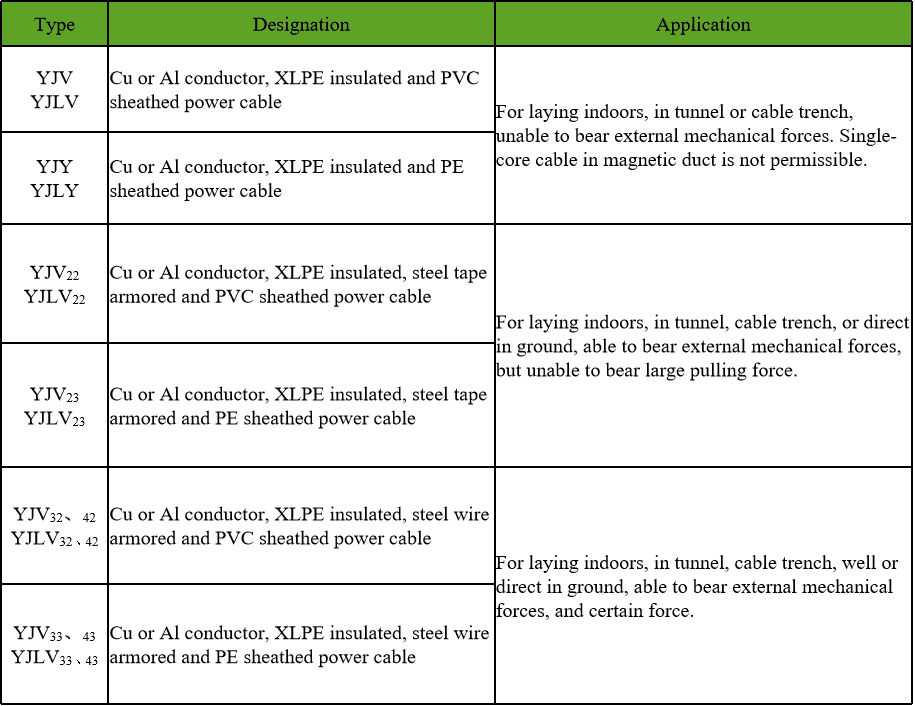

A power cable construction looks like a set of rings on the drawing, and each ring exists for one reason.
The conductor carries the current, the screen controls the electric field, the insulation holds the voltage, the bedding protects what it covers, the armor resists the route and the outer sheath keeps the environment out.
Because the layers depend on each other, a change in one is rarely isolated, which is why the drawing deserves a review before the order is placed.
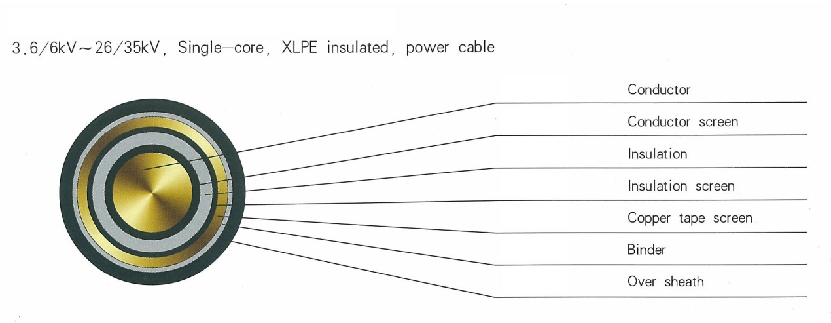
The Conductor and Its Screen
The conductor is stranded to a defined class so it can be bent and terminated, and its cross-section sets the current rating that everything else has to support.
Over the conductor sits a semiconducting screen. Its job is to smooth the electric field at the surface of the strands, where the field would otherwise concentrate on individual wires.
In a screened construction the screen is bonded to the conductor electrically, so it sits at the same potential and removes the air gaps that would otherwise discharge.
A power cable construction is a stack of layers, and each layer answers one specific problem rather than adding general protection.
Why Thin Layers Decide Performance
The two thinnest layers in a power cable construction carry most of the voltage duty.
- The conductor screen removes field concentration at the strand surface.
- The insulation thickness is set by the voltage class, not by the current rating.
- The insulation screen separates the insulation from the metallic screen and keeps the field uniform at the outer boundary.
- The metallic screen carries capacitive and fault current, and it is sized for the earth fault duty expected on the system.
Damage to any of these four shows up as a partial discharge finding rather than as an obvious fault.
Reading the cable cross-section layers in order shows quickly whether a quotation has answered the route conditions on paper.
Layer by Layer
This is the stack a reviewer should be able to trace on a power cable construction drawing.
| Layer | What it does | What to check |
|---|---|---|
| Conductor | Carries the load current | Material, strand class, cross-section |
| Conductor screen | Smooths the field at the strands | Presence, thickness, bond to conductor |
| Insulation | Withstands the system voltage | Compound, thickness, eccentricity |
| Insulation screen | Keeps the field uniform at the outer edge | Presence, overlap, adhesion |
| Metallic screen | Carries capacitive and fault current | Material, cross-section, contact |
| Bedding | Protects the layers under armor | Type, thickness, coverage |
| Armor | Resists route forces | Form, wire or tape count |
| Outer sheath | Keeps moisture and chemicals out | Compound, thickness, test record |
If a layer cannot be found on the drawing, ask which layer is answering that question instead.
The conductor screen and insulation screen are thin layers that decide whether the cable behaves at the voltage it is rated for.
Case: A Construction That Changed Quietly
Situation: A medium voltage feeder was approved from a datasheet that listed the voltage class, conductor size and overall diameter. The drawing followed some weeks later.
Finding: On review, the power cable construction had a metallic screen cross-section smaller than the fault duty required, and the bedding over the insulation screen was thinner than the earlier project the buyer had compared against.
Decision: The construction was re-quoted with the screen size and bedding stated explicitly, and the review checklist was updated to require the layer table with the quotation.
Result: The delivered cable matched the site fault duty, and later orders in the same programme were compared on the same layer table instead of overall diameter.
Cable bedding and armor work as a pair, since the bedding protects the layers underneath from the metal laid over them.
What to Verify on the Drawing
Four checks catch most construction surprises.
Trace every layer
Work from the conductor outwards and confirm that each layer named in the specification appears on the drawing.
Check the screen
Confirm the metallic screen material and cross-section against the earth fault duty, not only against the voltage class.
Compare thicknesses
Compare insulation and sheath thickness with the standard the project named, rather than with a previous project.
Look at the bedding
Where armor is present, confirm the bedding that protects the layers underneath it.
Send the construction drawing with the enquiry so the factory confirms the layer stack rather than only the outer size.
How Construction Shows Up in Test Evidence
Tests read the construction, so the two documents should agree.
| Test | What it reads | Construction link |
|---|---|---|
| Conductor resistance | Measured resistance of the strands | Conductor material and class |
| Insulation resistance | Leakage through the insulation | Insulation compound and thickness |
| Partial discharge | Field behaviour at voids and edges | Screen smoothness and bonding |
| Thickness and eccentricity | Insulation geometry | Extrusion control |
A finding in any of these sends the reviewer back to the layer that produced it.
Where Construction Choices Interact
Thickening the insulation to reach a higher voltage class also changes the cable diameter, the capacitance and the drum length, so the change rarely stops at one line of the datasheet.
Adding armor brings a bedding layer with it and raises the mass, which changes handling, cleat spacing and the joint bay arrangement at the same time.
Reviewing a power cable construction means following those knock-on effects rather than approving each layer in isolation.
Common Construction Mistakes
These appear repeatedly in technical reviews.
- Approving a construction from the overall diameter while the screen size goes unchecked.
- Assuming that two cables of the same voltage class and size carry the same screen and bedding.
- Comparing insulation thickness with a different standard than the one named in the specification.
- Accepting a datasheet that lists materials without stating thicknesses or the metallic screen cross-section.
Each of these is answered by the same layer table, provided the supplier completes it.
Construction Detail Worth Asking For
These fields turn a datasheet into a reviewable power cable construction.
| Field | Why it matters | Typical gap |
|---|---|---|
| Conductor class and material | Sets bending and termination | Listed as plain copper |
| Screen arrangement | Sets voltage and fault duty | Described only as screened |
| Insulation thickness | Confirms the standard used | Given as a range without a reference |
| Sheath thickness and compound | Sets route life | Compound named, thickness omitted |
Where a field is missing, the comparison rests on assumptions rather than on evidence.
Using the Drawing Through the Project
Once a construction is approved, the layer table becomes the reference for joints, terminations and accessories, because every interface is defined by the layers it has to rebuild.
It also becomes the reference for later phases, where the same route is extended and someone needs to know which layers were accepted and why.
A construction drawing that is kept current saves a full review each time a new drum is ordered for the same system.
RFQ Inputs for Construction Review
These details let the layer stack be confirmed at quotation stage.
- the voltage class and the system earthing arrangement
- the conductor material, strand class and cross-section
- the required screen arrangement and metallic screen size
- the insulation compound and the standard setting its thickness
- whether bedding and armor are required, and in what form
- the outer sheath compound and thickness
- the earth fault duty the screen has to carry
- the construction drawing and the test evidence expected with delivery
Technical references such as IEC 60502, IEC 60228 and IEC 60332 can align cable construction and test terminology. The approved project specification, applicable local rules and qualified design authority still govern the final system decision.
JINCHUAN Cable Support for construction review for LV, MV and screened cable types
JINCHUAN Cable supplies a layer table with the quotation and confirms each part of the power cable construction against the specification before production starts.
Review the cable range and the manufacturing profile, then send the construction requirements so the stack can be checked layer by layer.
Ask for the layer table with the quotation, and the construction review becomes a comparison instead of an interpretation.
FAQ
What are the main layers of a power cable?
A typical screened construction runs from the conductor and its screen, through the insulation and insulation screen, to the metallic screen, bedding, armor where fitted, and the outer sheath.
Why is there more than one screen?
The conductor screen smooths the field at the strands and the insulation screen keeps it uniform at the outer edge, so the two do different work in the same construction.
How thick should the insulation be?
Insulation thickness follows the voltage class and the standard named by the project, not the conductor size or the current rating.
What does the metallic screen carry?
It carries capacitive current in normal operation and the earth fault current during a fault, so its cross-section follows the fault duty.
What is the bedding for?
Where armor is fitted, the bedding protects the layers underneath from the metal laid over them and keeps the assembly stable.
Can the sheath be thicker than specified?
Thicker is not automatically better, because it changes diameter, mass and drum length, and the approved standard still defines the geometry.
How is construction checked in testing?
Routine and type tests read the construction, so resistance, insulation resistance, partial discharge and thickness results all relate to a specific layer.
Does the conductor class affect the construction?
Yes. A more flexible strand class changes diameter, bending behaviour and how the conductor sits in a lug or joint.
Why compare against the named standard?
Two standards can specify different thicknesses for the same voltage class, so a comparison only works when both cables follow the same reference.
How can JINCHUAN Cable help with construction review?
JINCHUAN Cable provides the layer table, the drawing and the test evidence that a reviewer needs to confirm each part of the construction.