Site Distribution Board Protection for Temporary Power
A site distribution board should provide coordinated isolation, overcurrent protection, earth-leakage protection and clear circuit identification at every distribution level. Its cable routes and test records must be reviewed as the site changes, because a temporary installation can remain exposed to water, impact and relocation for many months.
Source note: IEC 60364-7-704:2017. IEC 60364-7-704:2017 is the 3rd edition for construction and demolition site installations, published on 28 March 2017 with a stated stability date of 2029. Its scope covers both fixed and movable installations, so a site distribution board plan has to address the incoming point, area boards and final circuits rather than treating only the main enclosure.
"intended to be taken out of service upon completion"
Attributed to IEC 60364-7-704:2017.
Temporary power is the part of a construction site that everyone uses and few people design. The supply arrives, boards appear where they are needed, and circuits are extended as the work moves.
Legally and practically, none of that makes the installation less demanding. Water, impact, moving plant and constant reconfiguration are harsher conditions than most permanent installations ever experience.
What follows is a workmanlike view of how a distribution arrangement should be put together, where it usually fails, and what the records need to show when someone asks.
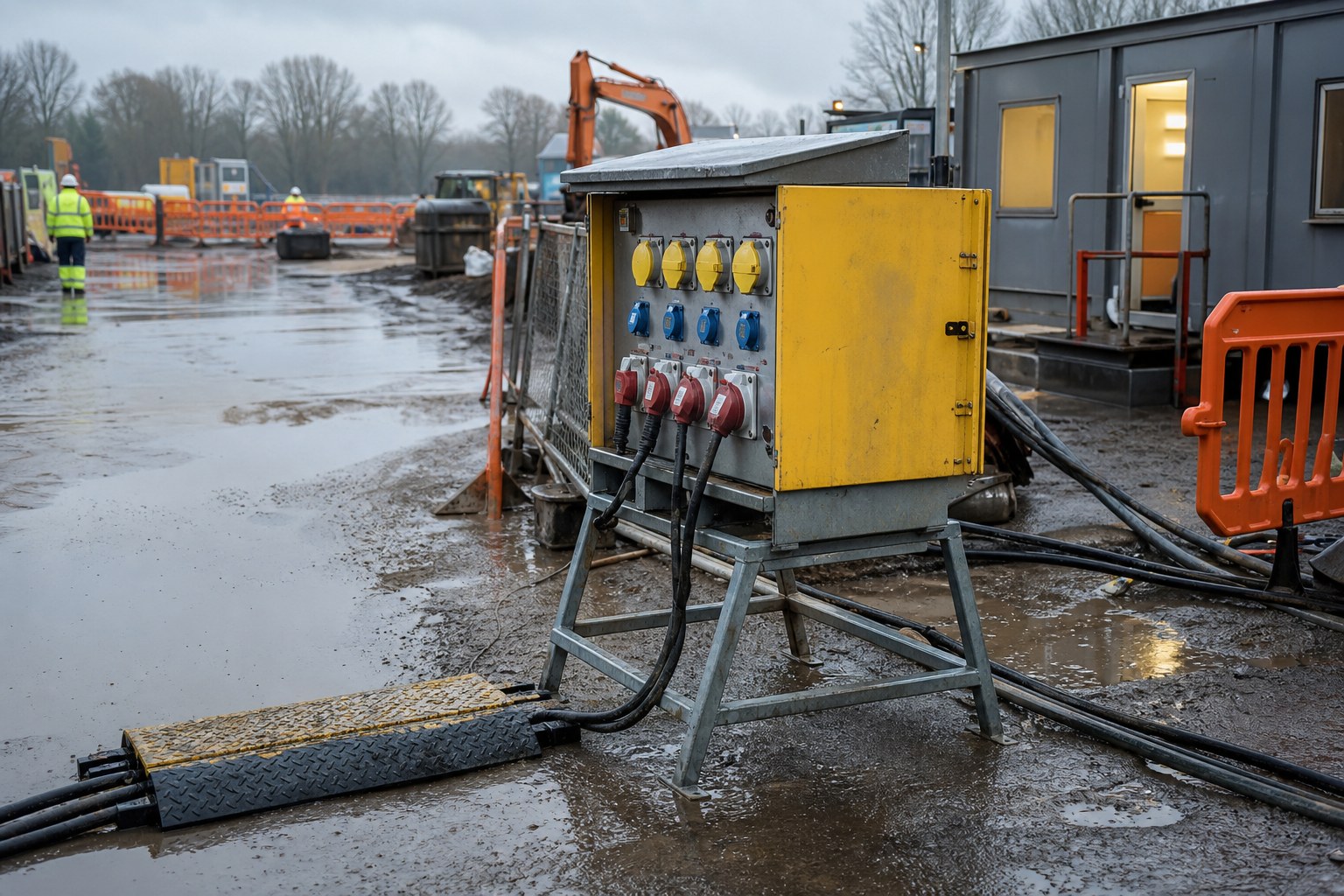
Why Temporary Power Deserves Fixed Standards
A permanent installation is designed once, tested and then left alone. A temporary supply is designed roughly, assembled quickly and altered continuously for the length of the project.
The protection still has to operate. The earthing still has to be continuous. The cable still has to survive being dragged over kerbs, run through puddles and coiled onto a pallet at the end of a shift.
Treating the temporary arrangement with the same discipline as a permanent one is not a bureaucratic habit. It is the difference between a supply that trips when something is genuinely wrong and a supply that trips at random until somebody disables the protection.
The site distribution board sits at the centre of that discipline, because it is the point where the arrangement is either coherent or merely convenient.
A site distribution board is the point where a supply that arrives as one cable becomes several circuits serving cabins, tools and temporary lighting.
How a Site Distribution Board Is Layered
A workable arrangement has a clear hierarchy, and every level has a defined job.
The incoming supply point
Where the supply enters the site, with isolation, metering and protection appropriate to the supply arrangement agreed with the network operator.
The main board
Where the supply is divided into a small number of submain circuits feeding the working areas of the site.
Area boards
Positioned where the work is happening, so that long trailing runs are shortened and circuits stay within sensible lengths.
Final circuits
Individual outlets and tools, each protected so that a fault in one does not remove power from the rest of the site.
Isolation and labelling
Every level should be capable of being isolated and identified, including the circuits that were added last week.
Earth leakage protection at a site distribution board has to work in wet conditions, which is exactly when nuisance tripping tempts people to bypass it.
Fixed and Temporary Distribution Compared
The electrical principles are the same, and the operating realities are not.
| Aspect | Permanent installation | Temporary site arrangement |
|---|---|---|
| Design life | Decades, with defined maintenance | Months to a few years, with constant change |
| Environment | Controlled or predictable | Water, mud, dust, impact and moving plant |
| Cable type | Fixed wiring methods | Trailing and re-usable cable with heavy sheathing |
| Change frequency | Rare and recorded | Weekly, often without documentation |
The second column is not a lesser version of the first. It is a different set of conditions that the equipment has to survive.
Every temporary supply has a designed life, and the cable, boards and protection should match the duration and the environment they are hired for.
Earth Leakage Protection and Why It Trips
Earth leakage protection exists to disconnect a circuit when current takes an unintended path. On a wet site, small leakage currents are normal, and that is what makes the setting a balance rather than a fixed answer.
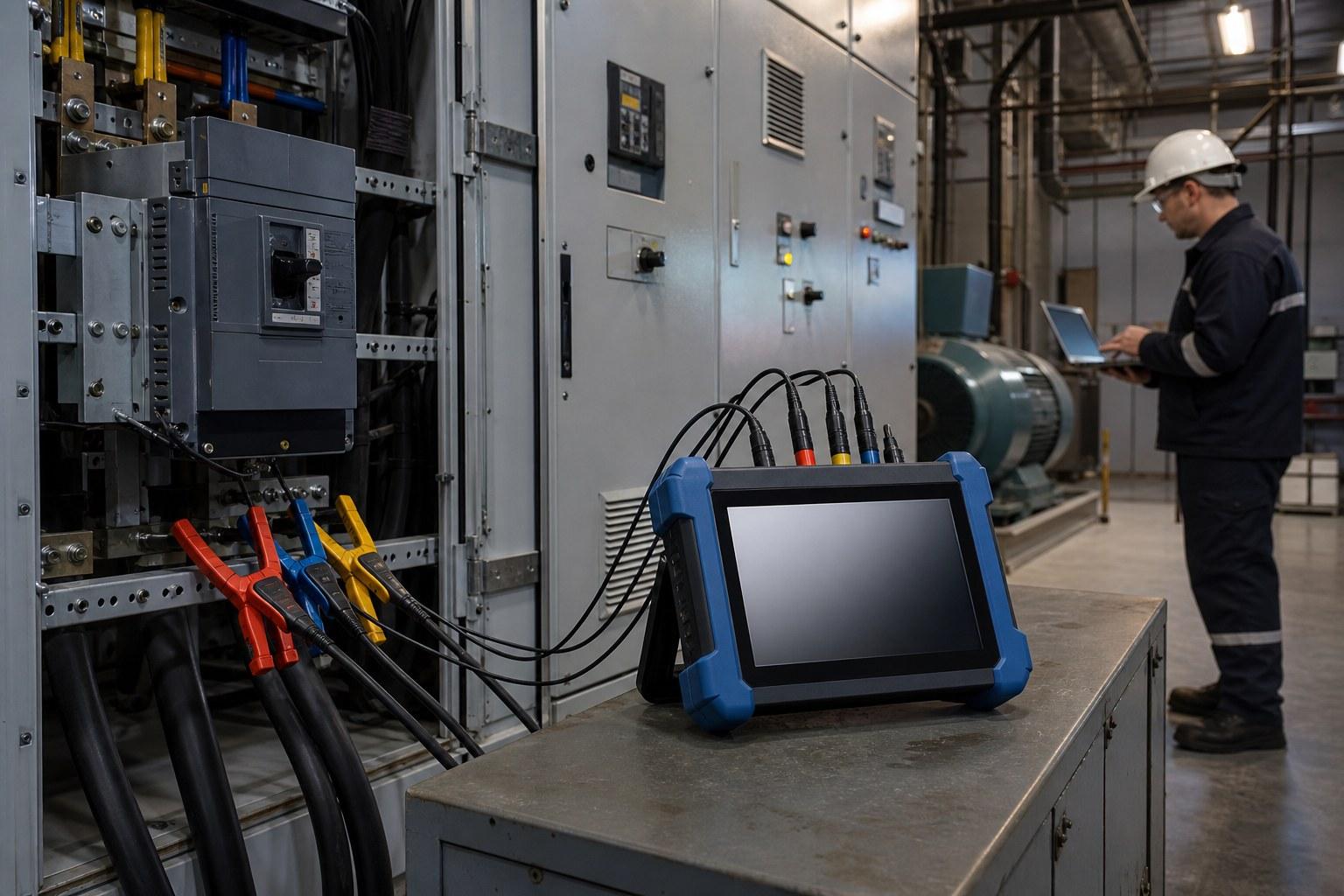
When a circuit trips repeatedly, the response that appears on site is usually to move the tool, swap the board or increase the rating. The response that solves the problem starts with measuring the leakage current in the circuit that trips.
Long trailing runs, damp connectors and damaged sheaths are the usual sources. A tool with a failing motor contributes as well, and so does a joint that has been taped rather than repaired.
The design consequence is that circuits should be short enough and separated enough that a fault is localised, so that a single tool cannot take out a whole area.
Trailing cable takes abuse that fixed cable never sees, so its sheath and its strain relief matter as much as its current rating.
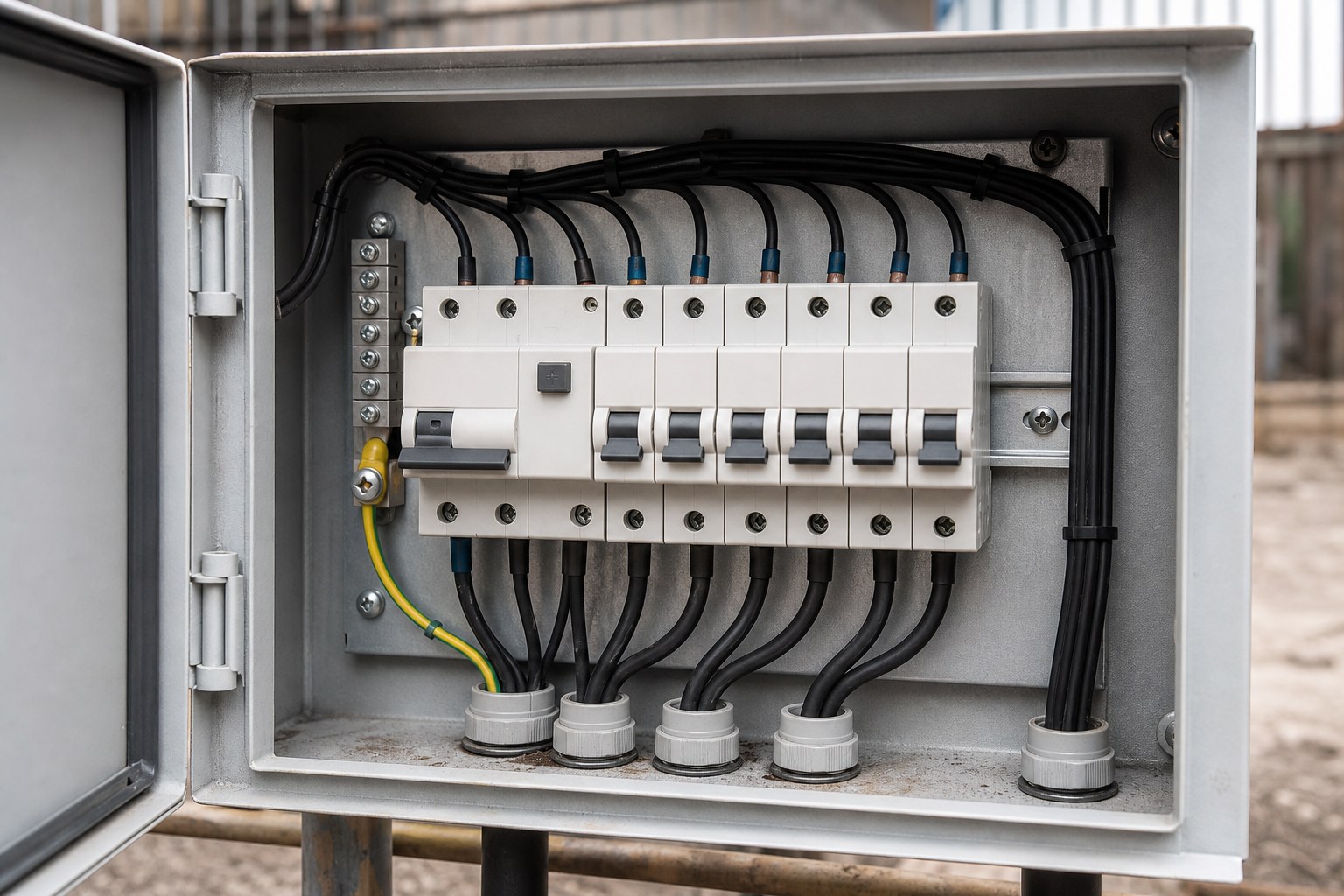
Cable Choice Along a Temporary Route
Five points that decide how long a temporary cable lasts in real conditions.
- A sheath that resists abrasion, because the cable will be dragged rather than laid.
- Strain relief at every plug and every connection, so the conductor is not carrying the load.
- Voltage drop checks on long runs, particularly where the run grows longer each week.
- Cable suitable for wet locations, with connectors that provide the same protection as the cable.
- Mechanical protection at crossings, where vehicles pass over the route rather than around it.
Each of these is a selection decision. None of them can be compensated for later by careful handling alone.
Final circuits on a construction site change weekly, and a site distribution board that is labelled as it changes is one that can be inspected without guesswork.
The Site That Tripped Every Wet Morning
Situation: A groundworks contractor found that part of the site lost power almost every morning after rain. The circuit involved fed two cabins and a group of tools through a long temporary run.
Finding: The leakage was not coming from one dramatic fault. A damp connector at a mid-point joint, a cable lying in a puddle and a tool with worn insulation each contributed a small amount, and together they were enough to operate the protection.
Decision: The circuit was split so that the cabins had their own supply, the mid-point connector was replaced, and the run was routed on cable stands clear of standing water. The suspect tool was removed for repair.
Result: Tripping stopped. The measured leakage in each new circuit was low enough that a single tool fault would operate protection without taking the rest of the area off supply.
Inspection and Test Points During the Hire Period
Temporary equipment needs checking more often than permanent equipment, and the checks are quick when the arrangement is orderly.
| Point | What is checked | Typical driver of the interval |
|---|---|---|
| Visual condition | Enclosure damage, cover integrity, cable sheath, plugs and connectors | Site conditions and frequency of movement |
| Protective conductor continuity | Earthing path through the board and along each trailing run | After every reconfiguration |
| Protection operation | Earth leakage device operation at each level of the arrangement | Scheduled interval set by the site |
| Records | Who inspected, when, what was found and what was done | Kept with the board, not in an office |
Intervals are set by the site's own management arrangements, and the value of a check depends entirely on it being recorded.
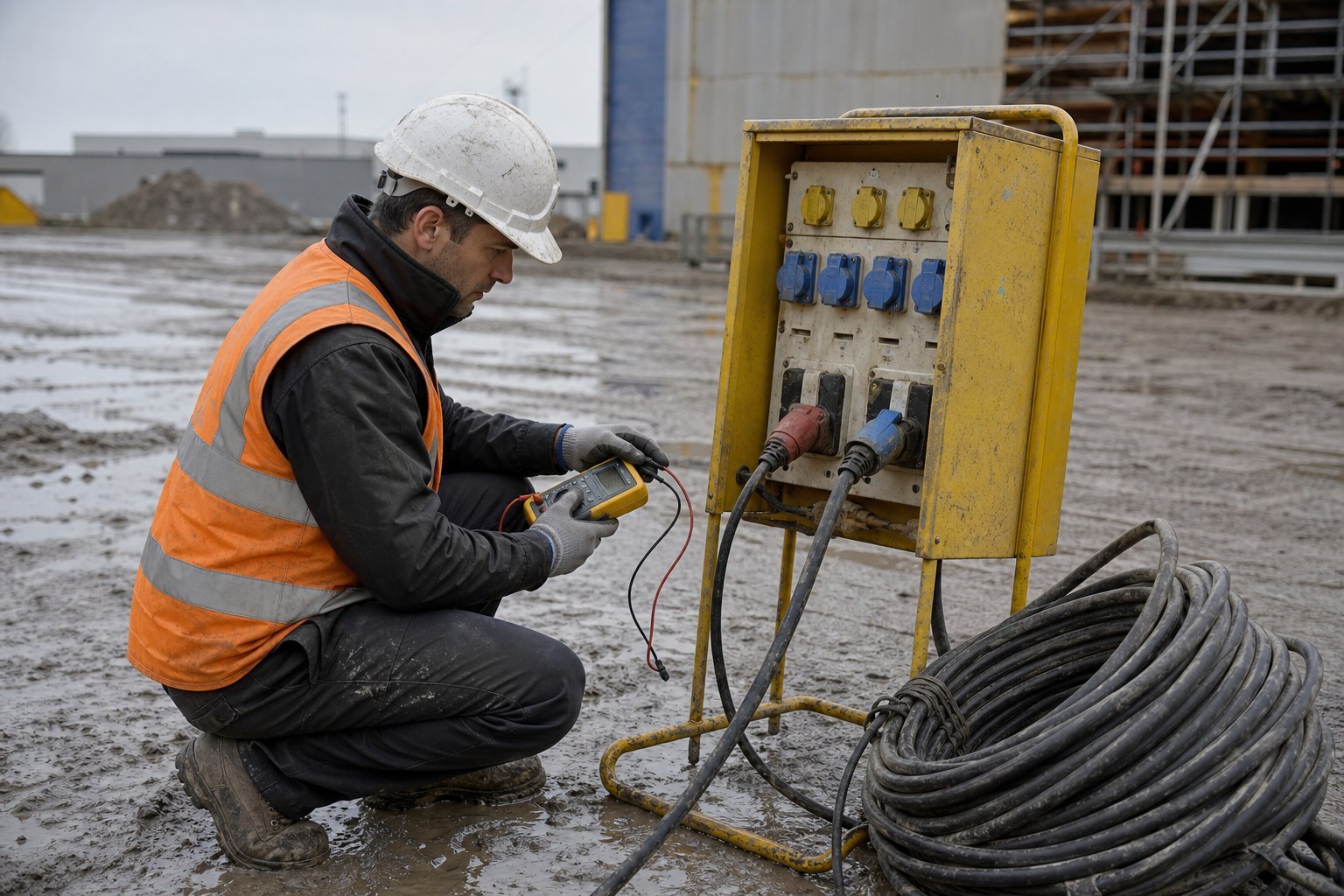
Impact, Water and the Reality of a Construction Site
Equipment rated for an outdoor environment is not automatically rated for a construction site. The difference is the impact, the mud and the fact that a cable will be moved by people who are concentrating on something else.
Boards should stand on a stable base, clear of traffic routes and above the level that water reaches in the worst week of the winter. Cable should cross vehicle routes in ducts or ramps rather than under loose boards.
Connectors are the weakest point in any temporary arrangement. They are also the part most often left on the ground, so the choice of connector is a decision about how the installation will be treated rather than about electrical ratings alone.
What Should Be Recorded on Each Site Distribution Board
Four labels and one folder turn a temporary arrangement into something that can be maintained and inspected.
Circuit identification
Every outlet labelled with the circuit it belongs to, updated when the arrangement changes rather than at the end of the project.
Protection details
The rating and type of each protective device, including earth leakage devices at every level where they are fitted.
Inspection record
Date, findings and the action taken, kept with the board so it travels with the equipment.
Contact and responsibility
The name of the person responsible for the supply, so that a question about a circuit has an identifiable owner.
Planning the Supply Before the Cabins Arrive
Five questions that are much cheaper to answer on paper than on site.
- Where will the main intake be, and who controls that position for the whole project?
- How many levels of distribution does the site actually need, given its size and layout?
- What is the longest run to the furthest working area, and what does that do to voltage drop?
- Which loads are sensitive enough that they should not share a supply with heavy plant?
- How will the arrangement change as the work moves, and who updates the labels?
A temporary supply planned in this way is not more expensive. It is simply designed before it is assembled.
RFQ Details for a Site Distribution Board
These details let the temporary arrangement, the cable and the protection be reviewed together before the boards are ordered.
- total connected load and the largest single load on the site
- supply arrangement, voltage and the protection provided at the intake
- number of distribution levels and the distance to each working area
- longest final circuit length and the tools it serves
- environmental conditions, including water, mud and vehicle traffic
- cable type expected for trailing runs and the connectors in use
- earthing arrangement and the protective conductor requirement
- inspection, labelling and record-keeping expected on site
Technical references such as IEC 60502, IEC 60228 and IEC 60332 can align cable construction and test terminology. The approved project specification, applicable local rules and qualified design authority still govern the final system decision.
JINCHUAN Cable Support for temporary site supplies and distribution boards
JINCHUAN Cable supplies cable for temporary and permanent power circuits, including constructions chosen for abrasion resistance and wet conditions.
Review the cable range and the manufacturing profile, then send the load and route details so the site distribution board arrangement can be matched to cable that suits it.
Read About JINCHUAN Cable or Contact JINCHUAN Cable with the project voltage, route and service conditions.
Decide the levels of distribution and the longest run before the cabins arrive, because a temporary supply that grows by improvisation is harder to protect and harder to inspect.
FAQ
What is a site distribution board used for?
It takes one incoming temporary supply and divides it into circuits serving cabins, tools and temporary lighting across the working areas of the site.
Why does earth leakage protection trip so often on site?
Small leakage currents from damp connectors, long trailing runs and deteriorating tools add together, and together they can operate the protection.
Is it acceptable to reset a tripping device repeatedly?
No. Repeated tripping is a symptom. The circuit should be measured and the cause found rather than the protection worked around.
Which cable suits temporary site work?
Cable with a robust sheath that resists abrasion and is suitable for wet locations, with connectors offering the same protection as the cable.
How often should temporary equipment be inspected?
The interval follows the site's own management arrangements and the conditions, and it is normally shorter than for permanent installations.
Does voltage drop matter on a temporary supply?
Yes. Runs on site grow as the work moves, and a circuit that was acceptable in month one may not be acceptable in month nine.
Should temporary circuits be labelled?
Yes. Labels should be updated as the arrangement changes, otherwise the board cannot be inspected or isolated reliably.
What about cables crossing vehicle routes?
They should pass through ducts or ramps, since loose boards and unprotected cable in a traffic route are a recognised cause of damage.
Can one board serve the whole site?
It can be attempted, and it usually produces long runs, poor discrimination and a single fault that removes power from everywhere.
How does JINCHUAN Cable help with temporary supplies?
JINCHUAN Cable supplies cable suited to temporary and permanent power circuits and can confirm constructions for wet and abrasive conditions.