
Voltage Sag Diagnosis Before Cable Replacement
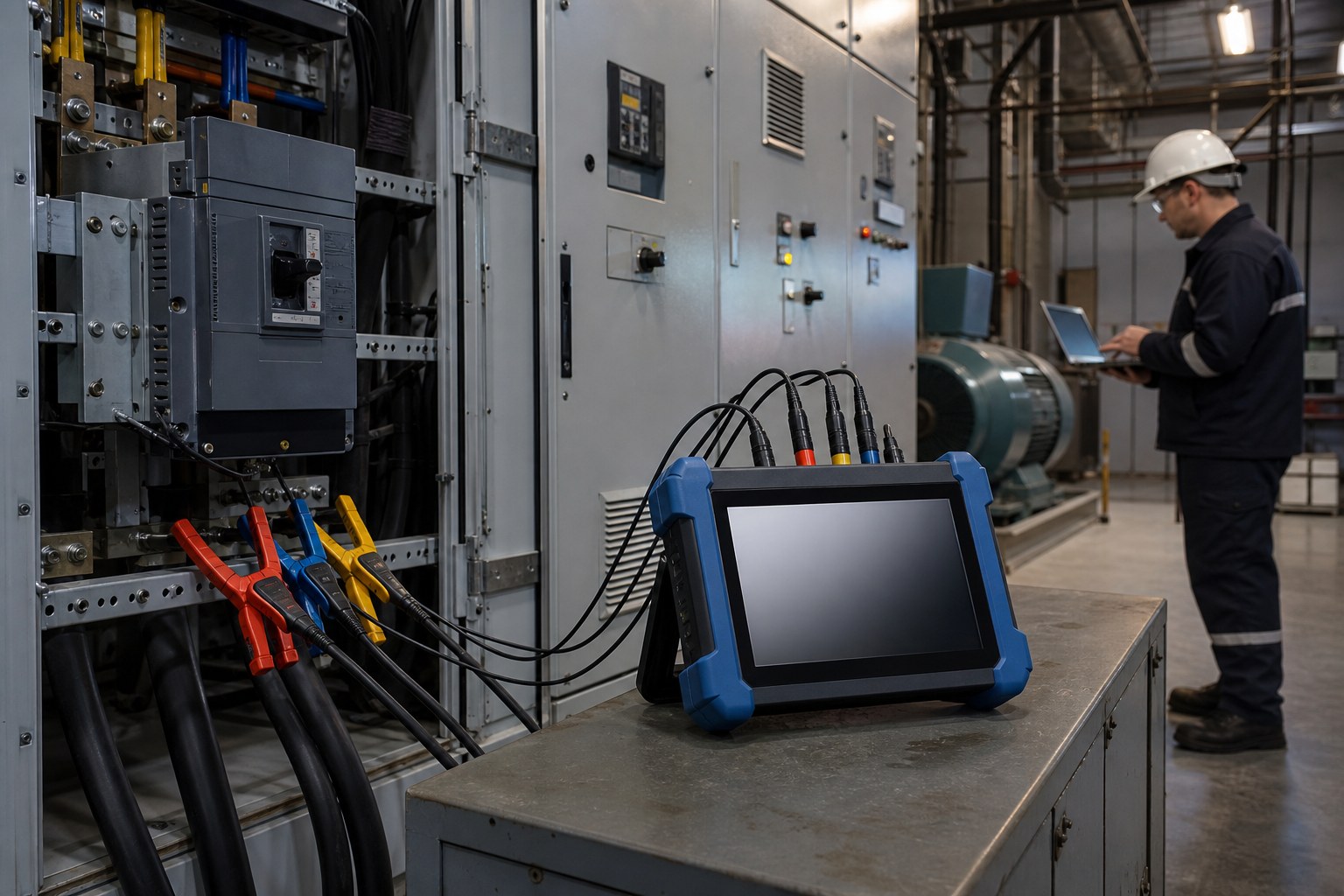
A voltage sag should be diagnosed from synchronized voltage, current and event-timing records before cable is replaced. Cable resistance and route length can affect the depth of a local event, but motor starting, upstream faults, transformer impedance and protection operation must be tested against the same timestamp.
Source note: IEC 61000-4-30:2025. IEC 61000-4-30:2025 defines power-quality measurement methods for 50 Hz and 60 Hz AC systems and retains 2 measurement classes, Class A and Class S. It includes supply-voltage dips and swells, interruptions, rapid voltage changes, harmonics and current measurements, which is why a voltage sag investigation should capture the event rather than rely on a single steady-state reading.
"reliable and repeatable results"
Attributed to IEC 61000-4-30:2025.
A production line stops without warning, the operator reports a flicker, and the electrical team is asked to find the problem. The cable is usually the first component suspected and often the last one that is actually responsible.
What happened is likely to have been a dip in supply voltage lasting a few cycles. Equipment with sensitive controls can drop out in that window even though nothing has failed.
Finding the cause means separating what the cable system does from what the rest of the installation is doing, and that separation depends on measurements taken at the right moment.
Voltage Sag Is a System Event, Not Just a Cable Problem
The supply feeding a plant is shared. A large motor starting somewhere else on the same network draws a current that depresses the voltage for everyone connected near it, including circuits that have nothing to do with that motor.
The same is true of a fault elsewhere on the system. Until protection clears it, the voltage across a wide area falls, and the fall is what disturbs control equipment.
That is why a voltage sag is described by its depth and its duration rather than by a single number. Two events with the same depth can have very different consequences depending on how long they last.
The useful starting point is therefore not the cable schedule but the event record: when it happened, how deep it went and how long it lasted.
A voltage sag is a short reduction in supply voltage, and its duration is measured in cycles rather than seconds.
What Cable Choice Can and Cannot Influence
Some of the behaviour belongs to the cable, and most of it does not.
| Effect | Influenced by cable selection | Dominated by other factors |
|---|---|---|
| Steady-state voltage drop | Yes, through conductor size and route length | Load current and supply voltage |
| Voltage sag during a remote fault | Very little | Fault level at the point of common coupling |
| Dip caused by a large motor starting | Partly, on the feeder to that motor | Motor starting method and upstream impedance |
| Sensitivity of control equipment | No | Equipment design and its own ride-through capability |
A cable can make a marginal situation worse and rarely makes a system problem disappear.
Power quality problems are shared events, so a single circuit rarely explains one on its own.
How a Voltage Sag Shows Up on Site
The evidence usually arrives second-hand, in the language of production rather than of power quality.
- A drive tripping on undervoltage while the process itself was running normally.
- Contactors dropping out and restarting, with the sequence lost rather than the power lost.
- Lights dimming briefly at the same moment as a large motor starts.
- Control equipment rebooting, which shows up as lost settings rather than as an obvious supply problem.
- Several unrelated circuits reporting disturbances at the same time, which points to a shared cause.
Recording the pattern across circuits is what turns a series of complaints into a diagnosable event.
Motor starting is the most common cause of a voltage sag inside a plant, because starting current is several times running current.
Motor Starting and the Feeder That Feeds It
A motor starting direct on line draws a multiple of its running current. On a strong supply that produces a modest dip; on a weak one it produces a dip that reaches equipment elsewhere in the plant.
The feeder to that motor has a part to play. A long or undersized feeder adds its own voltage drop to the drop caused upstream, and the motor terminal sees the sum of both.
That is why the answer sometimes involves the cable, but only the cable between the starter and the motor. Changing a feeder elsewhere will not change the dip experienced by control equipment on a different circuit.
Where starting performance is the problem, the methods that reduce starting current usually deliver more than a change of conductor size.
Voltage drop is a steady-state effect and a voltage sag is a transient one, and confusing the two leads to the wrong conclusion.
Measure Before Replacing Anything
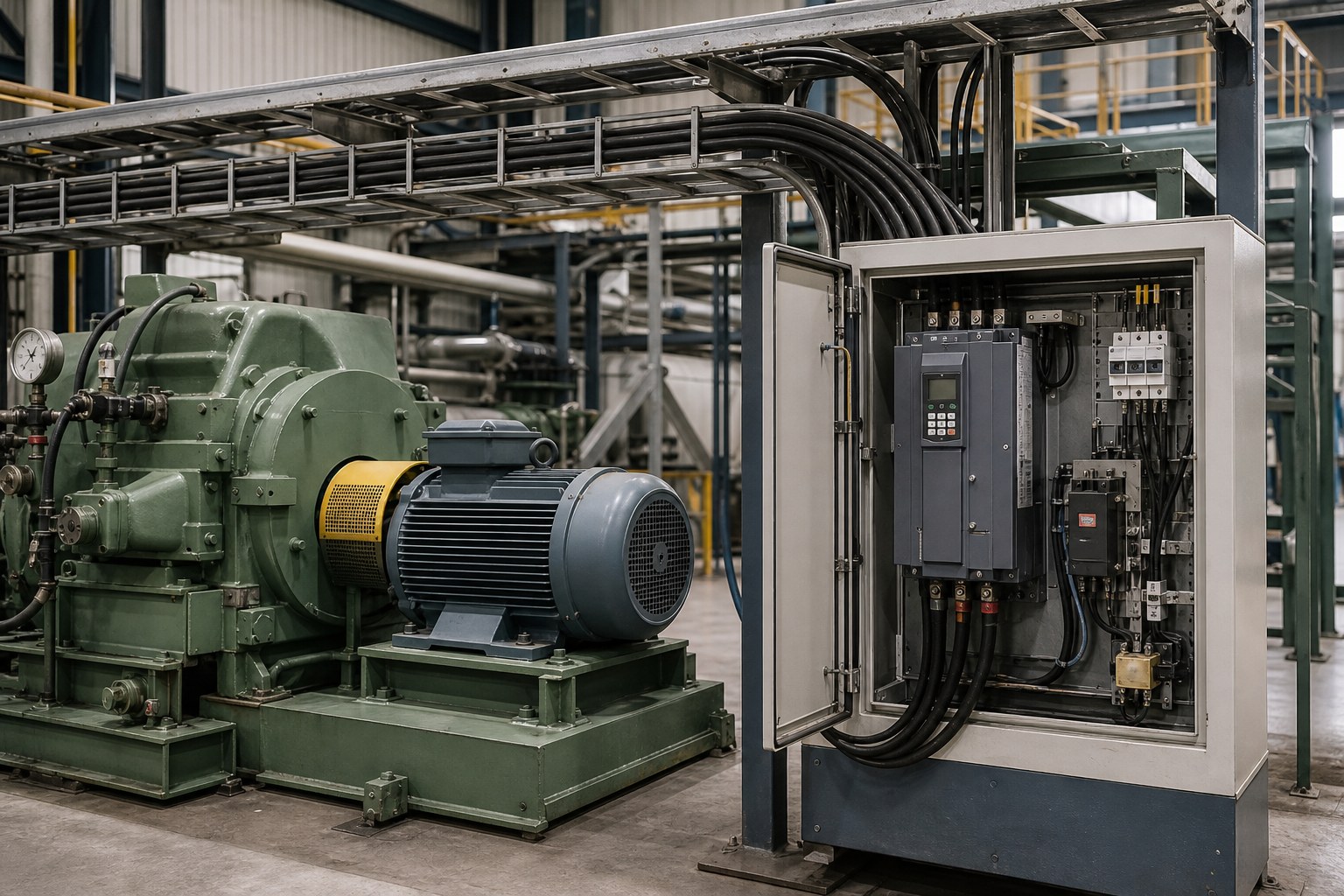
Five steps that turn a complaint into evidence.
Instrument the supply, not just the load
Recording at the point of common coupling shows whether the dip arrives from outside or is generated inside the plant.
Capture the whole event
Depth and duration together, with a timestamp that can be matched against process records and switching logs.
Record several locations at once
Two instruments on different circuits distinguish a shared event from a local one.
Note what started at that moment
Large motor starts, capacitor switching and supply transfers are the usual triggers on an industrial site.
Keep the records
A pattern across weeks identifies a recurring trigger far more reliably than a single capture.
Fault level describes how stiff the supply is, and a weak supply turns the same disturbance into a deeper dip.
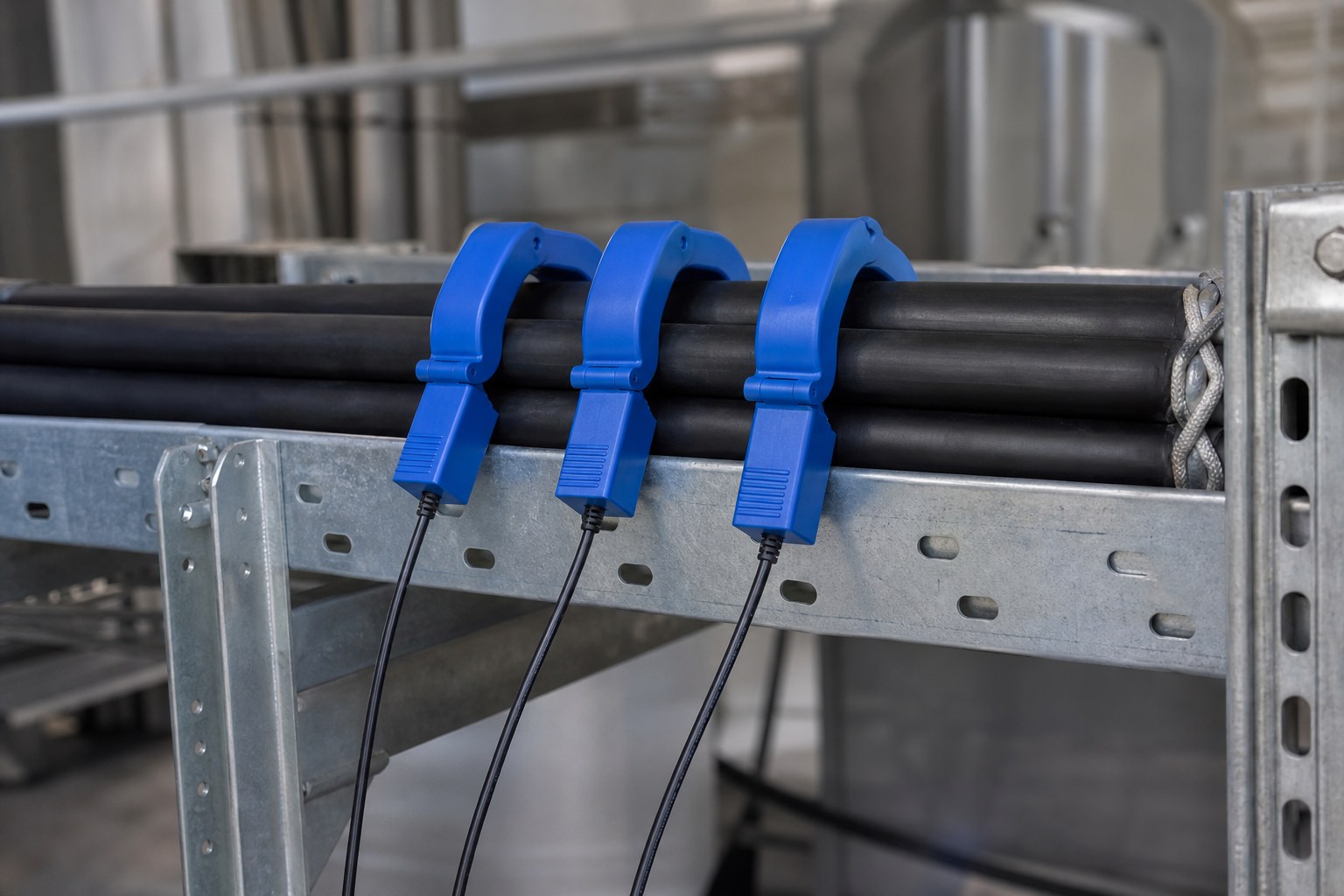
A Print Line That Stopped Twice a Week
Situation: A print line tripped out irregularly, roughly twice a week and always without a fault indication that pointed anywhere useful. The line was fed from a board that also supplied a large compressor.
Finding: Monitoring at two points showed that the supply voltage dipped whenever the compressor started, and that the dip at the print line was deeper than the dip at the board. The feeder to the line was long and was shared with other loads along its route.
Decision: The starting method for the compressor was changed so that it no longer started direct on line, and the feeder arrangement to the print line was separated so that it no longer shared a route with the largest motor loads.
Result: The irregular trips stopped and the line ran through a full production week without an unexplained stop. The cable itself was never at fault; the arrangement around it was.
Monitoring Records Worth Keeping
A short list of fields makes a power quality record useful months later.
| Record | Why it is kept | Practical detail |
|---|---|---|
| Depth and duration | Distinguishes a minor dip from an equipment-threatening one | Stored per event with a tolerance threshold |
| Timestamp | Allows comparison with process and switching logs | Synchronised across instruments |
| Location | Shows how far the disturbance travelled | Recorded for each measuring point |
| Connected loads | Explains what changed between events | Noted whenever a large load is added or removed |
Records that are not comparable between instruments rarely settle anything.
Conductor Size, Length and Everyday Voltage Drop
Voltage drop is the unglamorous part of the subject, and it is the part the cable genuinely controls. A long run with a small conductor loses voltage steadily, and the loss grows with the load.
Design limits for voltage drop exist so that equipment at the far end receives a voltage it can work with. Where the measured voltage at a motor terminal is already close to the limit, an occasional dip is much more likely to push equipment over the edge.
Correcting a voltage drop problem is straightforward: a larger conductor, a shorter route or a load moved closer to its supply. Each option has a cost, and the records show which one the situation actually needs.
What a Supplier Can Reasonably Confirm
A cable manufacturer can answer some questions precisely and should decline the others.
- Conductor resistance and the resulting voltage drop for a stated current and length.
- Short-circuit withstand for a stated fault current and duration.
- Construction details such as insulation, screening and sheath materials.
- Whether a proposed installation method matches the assumptions behind a rating.
- The point at which the question becomes a system study rather than a cable question.
A supplier who answers the last item honestly is more useful than one who guesses at the first four.
Turning Voltage Sag Notes Into a Cable Brief
When a power quality investigation finishes, the outcome is usually a set of changes: a starting method, a protection setting, a relocated load or, occasionally, a different cable.
If the cable is part of the answer, the brief should carry the measured current, the route length, the design ambient and the fault level at the point of connection, rather than a general instruction to upgrade.
Written that way, the request can be checked against a standard and against test data. Written loosely, it invites a range of offers that cannot be compared with each other.
RFQ Details for a Power Quality Driven Cable Change
These details let a cable proposal be checked against the measured conditions rather than against an impression of them.
- the measured event record, with depth, duration and timestamp
- locations of the measuring instruments and what each one recorded
- design voltage and the acceptable drop at the far end of the route
- route length as installed, including the section that will be replaced
- fault level and protection clearing time at the point of connection
- connected load, including the largest motor and its starting method
- installation method and design ambient temperature along the route
- records the owner wants kept once the change has been made
Technical references such as IEC 60502, IEC 60228 and IEC 60332 can align cable construction and test terminology. The approved project specification, applicable local rules and qualified design authority still govern the final system decision.
JINCHUAN Cable Support for power quality investigations and motor circuits
JINCHUAN Cable can confirm conductor resistance, voltage drop and short-circuit withstand for the cable being proposed, and can state the installation assumptions behind each figure.
Review the cable range and the manufacturing profile, then send the measured record so the request is built on data rather than on a symptom.
Read About JINCHUAN Cable or Contact JINCHUAN Cable with the project voltage, route and service conditions.
Instrument the supply before changing the cable, because a voltage sag that originates elsewhere will follow a new feeder just as happily as it followed the old one.
FAQ
What is a voltage sag?
A short reduction in supply voltage, usually lasting from a few cycles to a second, caused by a fault or by a large load such as a motor starting.
How is it different from voltage drop?
Voltage drop is a steady loss along a circuit carrying load, while a voltage sag is a transient event that affects the supply itself.
Can a cable cause a voltage sag?
A cable can add to the depth of a dip on its own circuit, and it cannot cause a dip that affects other circuits on the same supply.
Why do drives trip during a sag?
Their control electronics have a limited tolerance for undervoltage, and a dip lasting a few cycles is enough to reach it.
What information identifies the cause?
Depth, duration, timestamp and location. Comparing several measuring points shows whether the event came from outside or inside the plant.
Does a larger conductor solve the problem?
It reduces steady-state voltage drop and improves the position at the far end, and it does not change the fault level of the supply.
What is fault level?
A measure of how much current the supply can deliver into a fault, which indicates how stiff the supply is and how deep a dip becomes.
Should capacitor switching be considered?
Yes. Switching reactive equipment produces transients, and it is worth matching those events against the disturbance timestamps.
How long should monitoring run?
Long enough to capture several events, which is often weeks rather than hours.
How can JINCHUAN Cable help?
JINCHUAN Cable confirms conductor resistance, voltage drop and short-circuit withstand so the cable part of the question can be answered with figures.